



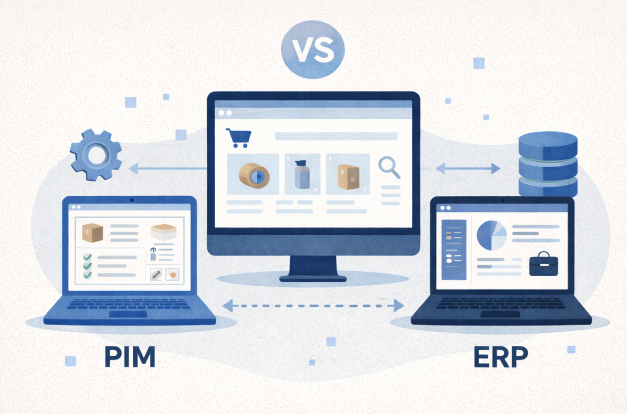
PIM versus ERP: when do you use which system and how to connect them
PIM and ERP are often mentioned in the same breath, but they serve different roles within the digital processes of trading companies. While an ERP system focuses on transactions and operational processes, a PIM system is entirely dedicated to managing and distributing product information.
In this blog, we explain the difference between PIM and ERP, when you need which system, and how both systems work together through integrations with ERP systems, webshops, and other digital platforms. This helps organizations set up product data in a scalable, consistent, and future-proof manner.
What is the difference between a PIM and an ERP?
In many trading companies, both ERP and PIM systems play a central role in digital processes. Yet these systems are often confused with one another.
An ERP system focuses on operational business processes such as procurement, sales, inventory management, logistics, and financial administration. It serves as the backbone of the organization and is primarily process-driven.
A PIM system focuses specifically on product information. Think of commercial product data, technical specifications, marketing texts, classifications, images, and documentation. The goal of a PIM is to centrally manage, enrich, and distribute consistent product data across all channels.
In short:
- ERP: manages transactions and processes
- PIM: manages product data and content
Both systems complement each other, but they solve different problems.
When do you need a PIM alongside an ERP?
Many ERP systems contain product fields, but they are not designed for extensive product enrichment or multi-channel distribution. As soon as product data becomes more complex, multiple departments work with it, or data needs to be published to multiple channels, limitations emerge.
A PIM is relevant when:
- Product information comes from multiple sources
- Marketing, sales, and e-commerce use the same data
- There are multiple languages, markets, or assortment structures
- Product data needs to be shared with customers, suppliers, or partners
In these situations, a PIM provides structure, control, and scalability that an ERP typically does not.
Can a PIM integrate with my ERP?
Yes, a PIM is almost always integrated with an ERP system. This integration forms the foundation of a reliable product data chain.
The ERP typically provides:
- Article structure and SKUs
- Basic product attributes
- Price and inventory data
- Supplier information
A PIM adds:
- Commercial product information
- Marketing content
- Enriched attributes
- Classifications such as GS1 or ETIM
Through integrations, data remains synchronized, while each system retains its own responsibility.
Integrating a PIM with a webshop or e-commerce platform
Beyond ERP integrations, a connection with webshops and e-commerce platforms is essential. These channels require rich, current, and consistent product information.
Typical data that flows from a PIM to a webshop:
- Product titles and descriptions
- Images and media
- Specifications and filters
- Categorizations and labels
A PIM ensures that product updates don't need to be manually made for each channel. This accelerates time-to-market and reduces errors.
Which PIM integrations are important?
The most important integrations around a PIM are:
- ERP systems for master data and process information
- Webshops and marketplaces for publishing
- Built-in DAM functionality for image and media management within the PIM
- External data standards such as GS1
- Customer or partner systems within the supply chain
A future-proof PIM architecture is flexible and can easily add new integrations.
How do product data flows move between PIM, ERP, and other systems?
For PIM and ERP to work well together, it's important to clearly define where data is managed and how it flows between systems.
In practice, this often looks like:
- The ERP system owns article structure, SKUs, basic attributes, prices, and logistics data
- A PIM owns commercial product information, enriched attributes, classifications, media, and channel-specific content
Data typically flows once from the ERP to the PIM for structuring and enrichment. From the PIM, product information is then distributed to webshops, marketplaces, catalogs, partners, and sometimes back to the ERP for enriched fields.
By clearly separating these responsibilities, you avoid duplicate entry, data conflicts, and unclear ownership.
Integrations as a strategic foundation
Integrations between PIM, ERP, and other systems are more than technical connections. They determine how scalable and future-proof your digital landscape is.
Without clear integrations, disconnected point solutions often emerge. This leads to manual work, data silos, and limited flexibility when new channels, countries, or systems are added.
A strategic integration approach ensures that:
- New sales channels are connected more quickly
- Multiple ERP systems or webshops can be supported
- Product data remains centrally managed, even as the organization grows or acquires new companies
This prevents the PIM system itself from becoming a new bottleneck in your IT landscape.
Common misconceptions about PIM and ERP
When comparing PIM and ERP, several assumptions come up frequently:
- An ERP can replace a PIM
- A PIM is only relevant for e-commerce
- Integrations are mainly technical
In practice, ERP systems are not designed for rich product content and multi-channel distribution. Sales, marketing, customer service, and partners also benefit from centralized product data. Integrations also determine how processes and collaboration are structured.
How do you determine if your organization is ready for a PIM?
An organization is often ready for a PIM when multiple of the following signals are recognizable:
- Product data is scattered across multiple systems and files
- Changes to product information take a lot of time
- Marketing and sales work with different versions of product data
- New channels or markets are difficult to connect
- Data quality is becoming increasingly important within the supply chain
A PIM helps make this complexity manageable by introducing structure, ownership, and scalability.
PLGGR within this landscape
Within this digital landscape, PLGGR positions itself as a provider of modern data and process solutions for trading companies. The PLGGR | PIM includes a connection to your ERP, an AI Assistant for product enrichment, and standard integrated DAM functionality, so images, documents, and other media are directly linked to product data.
This prevents the need for additional systems, simplifies management, and ensures that product information and media remain synchronized across all channels.
Conclusion
PIM and ERP each play their own role within the digital processes of trading companies. The ERP drives transactions and operational processes, while the PIM system ensures consistent, enriched, and scalable product information.
Through clear data flows, strategic integrations, and realistic expectations, a digital landscape emerges that grows with the organization. Not by replacing systems, but by making them work together intelligently.
For organizations that want to professionalize their product data and set it up in a future-proof manner, the combination of PIM, ERP, and well-thought-out integrations forms an essential foundation.
Explore the PLGGR PIM and discover how it works with your ERP →


