


Privacy and governance within the digital wholesale landscape
The digital wholesale landscape has changed rapidly. Data is no longer a supporting element but the backbone of commercial, operational and logistical processes. Product information, customer agreements, pricing structures and contracts continuously flow between systems, channels and partners. As a result, privacy and governance have become strategic priorities rather than purely legal concerns.
This blog explores what privacy and governance mean in the context of digital wholesale, why these concepts are closely connected and how they contribute to control, scalability and trust.
Privacy in a wholesale context
Privacy in wholesale is often associated with regulation, but in practice it extends much further. It includes personal data of customer contacts, as well as commercially sensitive information such as customer specific pricing, contractual agreements, volumes and historical order data. This information directly impacts competitiveness and therefore requires careful handling.
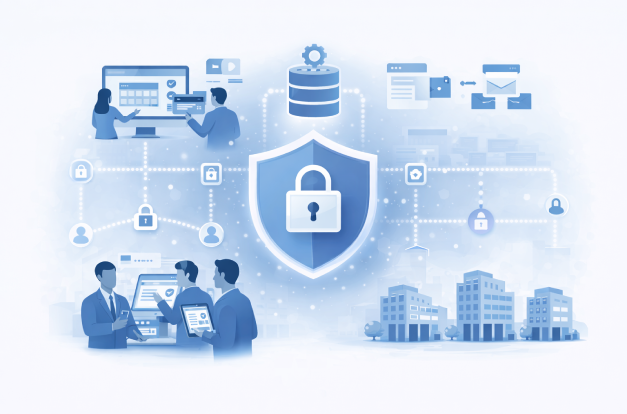
As wholesalers adopt B2B webshops, Order Entry applications, EDI connections and self-service portals, data is shared with customers, internal teams and external partners. Privacy in this environment means that data is only accessible to those who genuinely need it and that there is continuous insight into where data is used and for what purpose.
Governance as the backbone of digital control
Governance defines the structures, responsibilities and processes that enable organizations to stay in control of their digital landscape. In wholesale, governance determines who owns product data, who is allowed to make changes, how approvals are handled and how data is distributed across channels and systems.
Without governance, data becomes fragmented and inconsistent. Different departments start working with different versions of the truth. For wholesalers operating across multiple brands, countries or business units, governance is essential to maintain consistency while still allowing local flexibility.
The connection between privacy and governance
Privacy and governance cannot be separated. Governance provides clarity on responsibilities and processes, while privacy defines the boundaries within which those processes operate. Without governance, privacy rules are difficult to enforce. Without privacy, governance loses credibility with customers and partners.
Customer specific pricing illustrates this relationship well. Governance determines who can manage and publish prices. Privacy ensures that those prices are only visible to the correct customer. Together, they create controlled and trustworthy digital sales processes.
Digitalization and the rise of self-service
Digital sales channels have increased the importance of privacy and governance. Customers expect real time access to assortments, pricing and availability. At the same time, internal teams rely on the same data across ERP, PIM and CRM systems.
Without clear rules, data can be unintentionally shared, copied or modified. Governance establishes structured processes and role definitions. Privacy ensures that access remains appropriate and proportional.
Within the PLGGR platform, this is supported by centralized data models and role based access. This combination enables scalable self-service while maintaining control over sensitive information.
Regulation as a framework, not the objective
Regulations such as GDPR provide an important framework for privacy, but they are rarely the real objective. The true challenge lies in translating legal requirements into practical and workable processes. Wholesalers must be able to demonstrate which data they process, why they process it and where it is stored or shared.
Governance enables this translation. When privacy is embedded into daily operations, compliance becomes a natural outcome rather than an administrative burden.
Privacy and governance within PLGGR
PLGGR is built on the principle that privacy and governance should be integral to the platform, not added afterwards. Access rights are based on roles and responsibilities. Product managers, sales teams and external partners each see a different perspective on the same underlying data. This approach supports privacy while making governance tangible and enforceable.
Managing multi company complexity
Many wholesalers operate in multi company structures that require both central coordination and local autonomy. This balance often puts pressure on governance.
PLGGR enables shared product structures and classifications at a central level, while allowing prices, content and assortments to be managed locally. This reduces duplication, limits errors and strengthens control over privacy sensitive data.
Product information as a governance foundation
Product information is at the core of nearly every digital wholesale process. Governance defines how this information is created, enriched and published. Privacy becomes relevant as soon as product data is combined with customer specific agreements.
By managing product information centrally and distributing it in a controlled manner to B2B webshops, Order Entry applications and other channels, organizations maintain full visibility into data usage. This visibility is critical for audits, scalability and trust.
Integrations and controlled data flows
Wholesale organizations rarely operate with a single system. ERP, WMS, CRM and external platforms exchange data continuously. Governance defines which data is shared and under what conditions. Privacy requires these data flows to be secure and limited to what is strictly necessary.
PLGGR acts as a central orchestration layer, keeping integrations manageable and transparent. This simplifies compliance efforts and supports predictable growth.
A practical scenario
Consider an international wholesaler operating multiple brands across several countries. Customers access personalized pricing and assortments through digital channels, while internal teams work with shared product data.
By organizing privacy and governance centrally within PLGGR, the organization can scale with confidence. Customers only see their own data, internal teams work with a single source of truth and digital processes become more reliable and efficient.
Value for the organization and its customers
A mature approach to privacy and governance brings clarity and stability. Employees understand their responsibilities and customers experience consistent and secure digital interactions. Innovation becomes easier because the underlying rules are clear.
For wholesalers aiming to increase digital maturity, privacy and governance are not final goals but ongoing disciplines that evolve alongside the organization.
Final thoughts
Privacy and governance are no longer abstract concepts in digital wholesale. They form the foundation for scalable digital operations, reliable data and sustainable customer relationships. By embedding these principles into processes and platforms, wholesalers create room for controlled growth.
PLGGR supports this approach by treating privacy and governance as core elements of the digital ecosystem rather than afterthoughts.


